

What is assertiveness?
Being assertive is a skill that allows you to stand up for your own, or other’s, rights. It means that you listen and talk (rather than dominate or take a back seat), but you still get your point across fairly.
If you’re not assertive, what are you instead?
You might be passive, aggressive or passive-agressive. We’ll go through each one in turn:
Passive – this is when we don’t stand up for ourselves, and other people tend to take advantage or bully us for it. We may have strong feelings but aren’t able to voice them. Perhaps we lack confidence. Unfortunately, if we never practice trying to be more assertive, our confidence falters even more.
Aggressive – this is when we are very open and angry about what we want, which can scare others or make them defensive towards us. We might shout or be violent.
Passive-aggressive – this is when we pretend to be ok, but actually we’re really feeling a strong emotion deep down. It’s not allowing us to be open and honest about what’s happening for us. Instead, we might express some of those feelings indirectly through being hostile, making subtle rude comments, or criticising others.
You might also find this image useful to differentiate between the four types based on openness of communication and consideration for others:
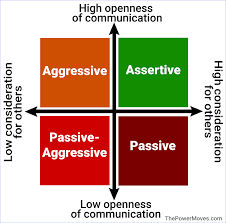
As you can see, being assertive is the perfect blend of a high openness of communication and a high consideration for others, which are both vital in maintaining healthy relationships with others.
What are the benefits of being assertive?
Generally speaking, you’ll feel better in yourself and have higher self-esteem if you’re able to stand up for yourself. We often don’t feel too great when we’ve been aggressive towards someone, or too passive about expressing what we really feel.
You’ll also be more respected by those around you. When we get angry or passive-aggressive, other people don’t wish to listen to us; therefore, our communication becomes pointless, and their respect tends to drop. If we’re too passive, people might walk over us, therefore not showing us respect in this way either.
Three steps to being assertive
We can use these three steps (or sometimes just two of them) to help us become more assertive.
- Explain the situation. Tell them what is happening right now/has happened.
- Tell them how you feel (this step isn’t always as relevant, e.g. if it’s to a stranger in a shop).
- Explain what you would like to happen.
For example, if someone fell out with you and it’s unclear why, you might say: ‘I get the sense that you’re really angry with me (step 1), but I’m confused why (step 2). Please can you tell me what I’ve done? (step 3)’. This would be much more assertive than ‘you’re so annoying, just tell me what I did wrong!’ and will hopefully lead to a more fruitful conversation.
Here is another top tip: try to avoid saying ‘you make me feel…’ to other people. When we put our feelings on someone else, we’re not taking ownership of them. We may also make the other person feel defensive if they didn’t mean to make us feel this way. Instead, try to own your feelings and say ‘I feel….’
Have a go, and see how you get on! You can always practice this skill with various scenarios with a loved one, if this is something that you struggle with.
Get in touch for further support
If you are interested in using our service to build assertiveness in a 1:1 way, we provide CBT and psychotherapy to adults and children aged 7+. Please don’t hesitate to contact us using the enquiry form below (or scroll down for further self-help resources):

Get in touch to discuss your counselling needs
and find the right therapist for you
Please fill in the details below, then press ‘submit the form’. Our Clinic Manager, Rhianna, will review the form and be in touch via email within 1 working day to discuss her recommendations. If we can help, we will provide you with a link to book an assessment with the most appropriate therapist.
Thank you for your response. ✨
Join our mailing list
You can also follow us on our Instagram and Facebook for more information and mental health discussions. Or sign up to our mailing list to follow our blogs and offers, below:

Join our mailing list
Get new blog content delivered directly to your inbox, including a free resource to boost your self-esteem that includes a quiz and a CBT technique.
You’ll also be the first to hear about new blog articles, resources, tips, advice, offers and updates on our service including our widely anticipated self-paced online courses which cost the fraction of 1:1 therapy.
Just pop your email in the box below, and don’t forget to check your junk inbox it it doesn’t arrive soon.
I’ve found this advice really helpful and easy to understand. Thanks Anjali.
Thank you so much Pam! We’re glad you found it helpful.